WASHINGTON, D.C. — For months, the official narrative from the White House and the Pentagon has been one of total air superiority and a “locked and loaded” arsenal. President Trump has repeatedly claimed that Iran has “nothing left” and that anyone questioning American victory is “committing treason.”
But a massive, month-long investigation by CNN—utilizing high-resolution satellite imagery, dozens of sources within the Gulf States, and months of internal damage assessments—has shattered that veneer. The reality is not just different from the official line; it is its polar opposite.
The investigation reveals a story of unprecedented destruction, where systematic Iranian strikes, aided by sophisticated Chinese technology, have crippled a majority of American military positions across the Middle East. From “virtually unusable” bases in Kuwait to the destruction of irreplaceable surveillance assets in Saudi Arabia, the American “micro-cities” in the desert have been transformed into what allies are now calling “sitting ducks.”
The Scale: 16 Installations, 8 Countries
While the Pentagon maintained that U.S. forces remained “fully operational,” CNN’s analysis confirmed that at least 16 American military installations across eight countries were damaged. These include major hubs in:
-
Kuwait (Camp Buehring)
-
Bahrain (NSA Bahrain – 5th Fleet HQ)
-
UAE
-
Saudi Arabia (Prince Sultan Air Base)
-
Jordan
-
Iraq
-
Qatar (Al-Udeid Air Base)
This represents the vast majority of the American military footprint in the region. According to a U.S. source familiar with the situation, the strikes were not the desperate, random volleys of a dying regime. They were “rapid, targeted strikes using advanced technology” that catch the U.S. base-defense systems in a state of shock.
The “Eyes” and “Ears” Destroyed
Iran did not shoot blindly. The investigation confirms a systematic targeting campaign against the most expensive and difficult-to-replace assets in the U.S. inventory.
1. The Boeing E3 Sentry (The “Eyes”)
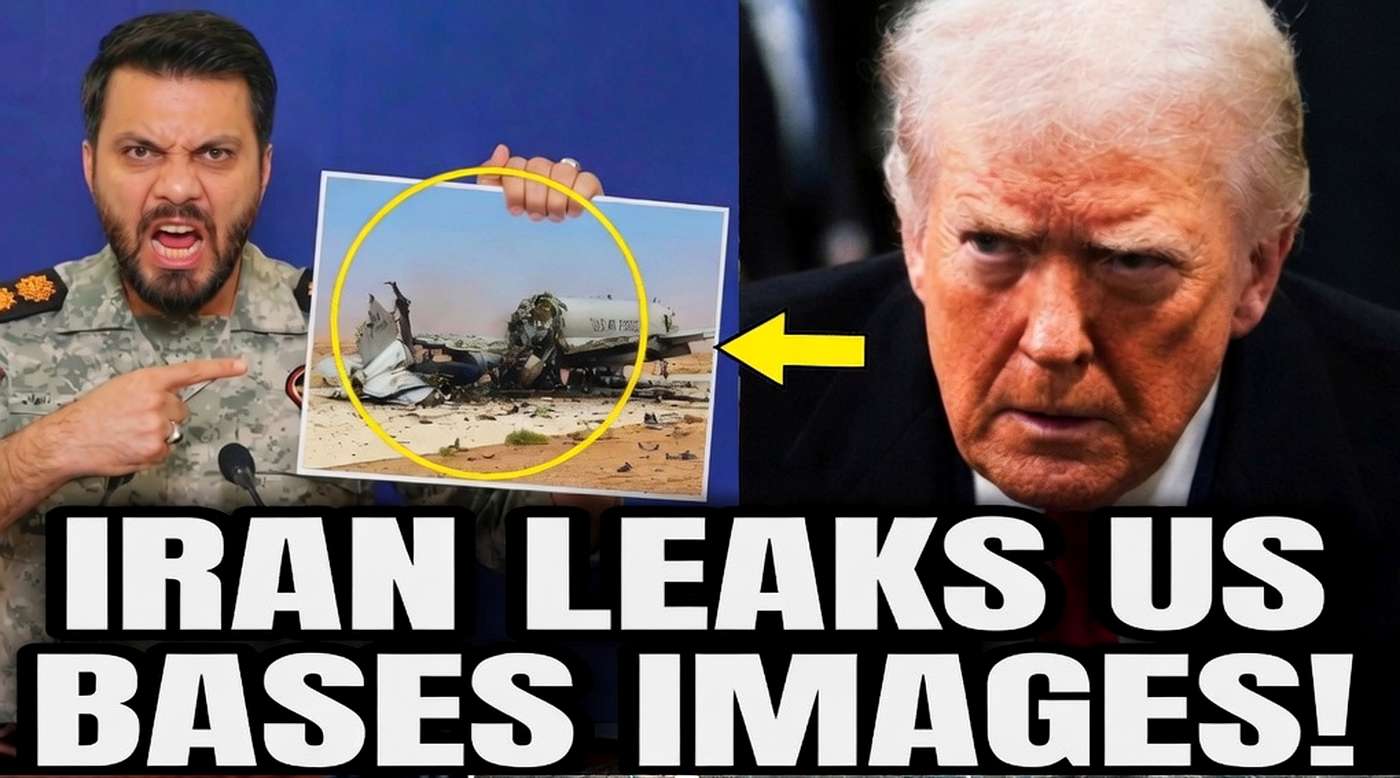
At Prince Sultan Air Base in Saudi Arabia, an Iranian strike destroyed a Boeing E3 Sentry surveillance aircraft. This plane provided the U.S. with massive visibility over the entire Gulf.
-
The Cost: In today’s money, nearly half a billion dollars.
-
The Problem: It is out of production. It cannot be replaced. The “Eyes of the United States” in the Gulf have been effectively blinded.
2. The Raydomes (The “Ears”)
Raydomes—those giant, golf-ball-shaped structures—protect the satellite dishes vital for data transmission and military communication. At a single major installation, Iran destroyed all but one raydome in less than a month. Without them, the communications backbone of U.S. operations is exposed and degraded.
3. Radar Systems (The “Shield”)
Radar systems are described by congressional aids as the “most expensive and most limited resource” in the region. Iran targeted these specifically because their destruction renders air defense systems—like the Patriot batteries—virtually useless.

The Chinese Connection: The TE01B Satellite
How did Iran achieve such surgical precision? The answer lies in 2024, when Iran secretly acquired a Chinese satellite known as the TE01B.
Before this acquisition, Iranian intelligence relied on blurry, low-resolution imagery. Now, they possess high-resolution data almost as detailed as what the U.S. sees. CNN’s side-by-side comparison shows the staggering difference: Iran can now see individual aircraft, specific vehicles, and even individual radar installations.
This is the first time in military history that the United States has fought an adversary with comparable satellite imaging capabilities.
The “Inventory” Myth: Stocks vs. Reality
President Trump claimed today that U.S. inventory is “more than double” what it was at the start of the war. However, Seth Jones, Director of the International Security Program at CSIS, described these claims as “extremely misleading.”
While the U.S. may have “missiles in general,” the specific, long-range munitions required for high-end deterrence—Tomahawks, JSMs, and long-range anti-ship missiles—are in “very limited supply.”
-
Iran’s Survival: Despite the barrage, Iran still has roughly 40% of its drone capabilities and 60% of its missile launchers operational, many of which were hidden in dispersed, underground facilities.
Allies in Retreat: The Saudi “Hedge”
Perhaps the most significant damage isn’t to the buildings, but to the alliances. Saudi Arabia, America’s longest-standing Arab ally since the 1940s, is now telling CNN that the alliance with the U.S. “cannot be exclusive and is not impregnable.”
Gulf states are watching U.S. troops work out of hotels and apartments because their bases are “sitting ducks.” This realization is pushing traditional U.S. allies to start hedging their security, building relationships with China and Russia as backup guarantors. The architecture of American power in the Middle East is shifting irreversibly.
The True Cost: $50 Billion and Counting
The Pentagon has publicly requested $25 billion for the war. However, when reconstruction costs for 16 bases across eight countries—plus the replacement of irreplaceable assets like the E3 Sentry—are factored in, the real cost hits $40 to $50 billion.
During budget hearings, Pentagon officials admitted that “reconstruction costs are not reflected” in the current fiscal year 2027 requests. This means the bill for rebuilding America’s Middle East footprint has not yet been explained to the American taxpayer.
Conclusion: What “Winning” Looks Like
The E3 Sentry is gone. The raydomes are gone. Radar systems are damaged. The “war room” in Qatar was hit twice. U.S. troops are in hotels, and the bases are empty.
If this is what “locked and loaded” winning looks like, the strategic implications for the future—specifically a potential conflict with China in the Indo-Pacific—are terrifying. If Iran can do this with a single Chinese satellite, a conflict with China itself would face a fundamentally different order of magnitude.
As Jack Mercer concludes: “Fact check everything. And whatever you do, don’t look away.”