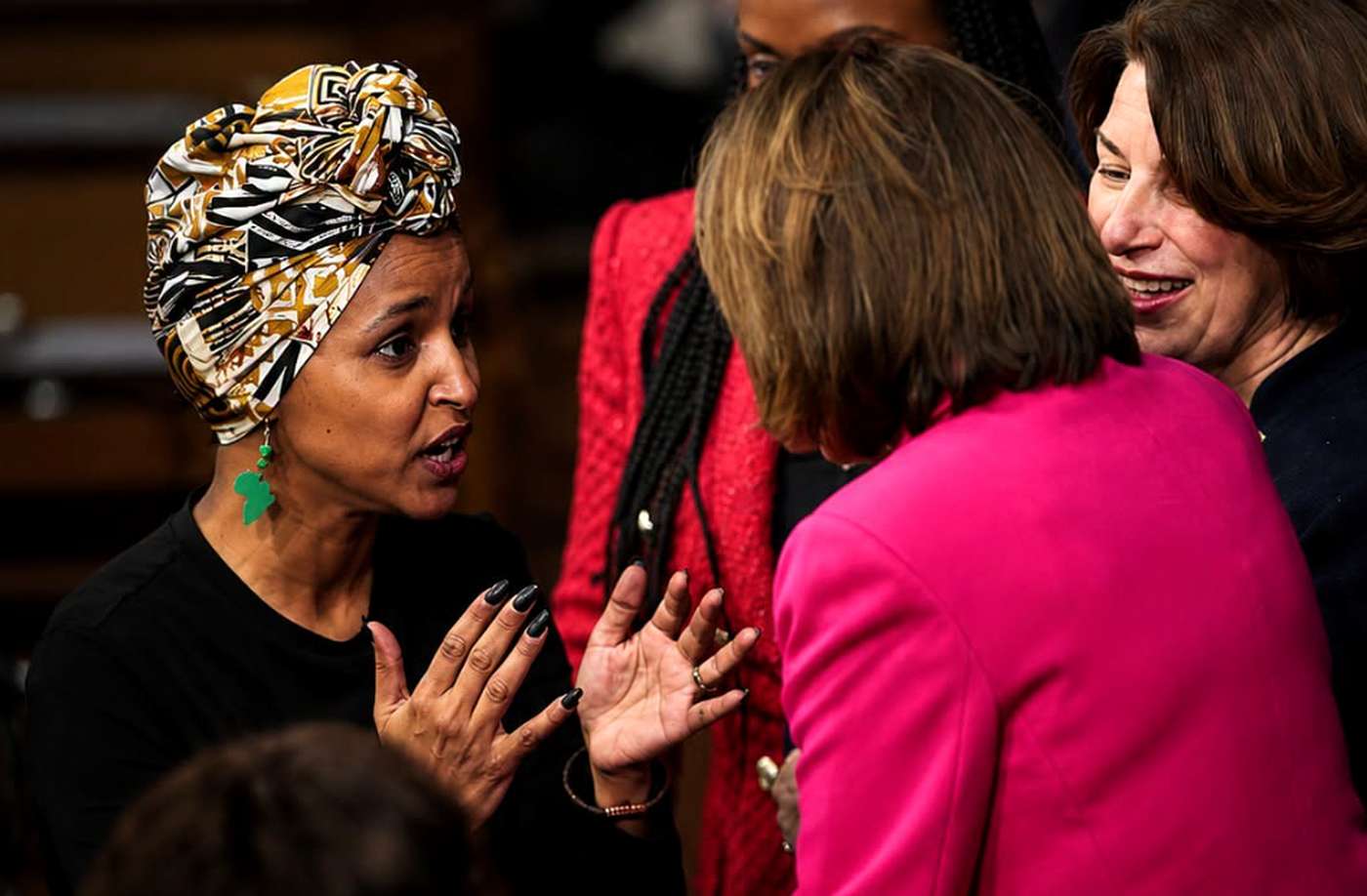
Rep. Ilhan Omar hasn’t had much luck in getting her left-wing socialist agenda through Congress, and she wound up on the wrong side of a pair of bills on Wednesday.
The House voted on legislation to restrict stock trading by members and their families, as well as the National Defense Authorization Act, the latter being the annual Pentagon spending bill, neither of which she supported.
Both, however, passed.
Regarding the stock trading legislation, however, the troubled Minnesota Democrat may ultimately get her way: The bill is widely expected to die in the Senate, where Republican leaders have shown little interest in advancing it.
Meanwhile, some lawmakers in both the House and Senate argue the legislation does not go far enough to address potential conflicts of interest between members’ official duties and their personal financial holdings, NOTUS reported.
The Stop Insider Trading Act passed the House by a 232-198 vote, with 13 Democrats joining Republicans in support.
Under the bill, lawmakers and their immediate family members would be allowed to keep the individual stocks they already own and sell them over time.
The legislation would also require members of Congress to publicly disclose plans to sell stock holdings between seven and 14 days before completing a transaction.
The bill further establishes penalties for disclosure and trading violations, imposing a fine of either $2,000 or 10% of the transaction value, whichever is greater.
House Republicans combined the measure with provisions from another bill that would require voters to present photo identification to cast a ballot, a proposal that is one of President Donald Trump’s top legislative priorities ahead of the midterm elections, NOTUS reported.
Rep. Chip Roy, R-Texas, who has worked on several congressional stock-trading ban proposals over the past decade, said on the House floor Wednesday that he would have preferred a standalone vote on the stock-trading provisions.
Still, Roy said he was “proud of the legislation.”
“This is a giant step forward. I wish my colleagues on this side of the aisle and my colleagues on this side of the aisle would recognize that and praise it,” Roy said.
Meanwhile, the House narrowly passed its version of a sweeping defense policy bill on Wednesday, another bill Omar opposed.
The measure approved a record $1.15 trillion Pentagon budget amid continued uncertainty over the future of the conflict with Iran.
The proposed funding, an increase from the $900.6 billion authorized last year, drew criticism from lawmakers who argued Congress should not continue allocating money for the conflict with Iran, particularly as the national debt continues to grow.
The House approved its fiscal 2027 National Defense Authorization Act by a 216-212 vote, with three members not voting. A total of 209 Republicans supported the measure, while 205 Democrats opposed it.
Seven Republicans and six Democrats broke with their parties on the final vote.
Among its provisions, the bill would officially rename the Department of Defense as the Department of War.
It also includes a 5% to 7% pay raise for service members, expands the active-duty military, and requires nine Southern military bases to revert to names replacing those adopted in 2023, when installations were renamed to remove Confederate references.
During Wednesday’s debate, lawmakers argued over the legislation’s merits, with supporters emphasizing the need to strengthen America’s national defense at home and abroad.
Members of both parties also blamed the opposing side for the nation’s current security challenges.
“The Democrats have gone on time and time again with this unprecedented obstruction,” House Budget Committee Chairman Rep. Jodey Arrington, R-Texas, said in the session.
“Recently, they blocked the National Defense Authorization Act to protest President Trump and our troops’ efforts to stop this radical terrorist regime from having nuclear weapons,” Arrington added, referring to Senate Democrats blocking that chamber’s version of the 2027 NDAA last week.