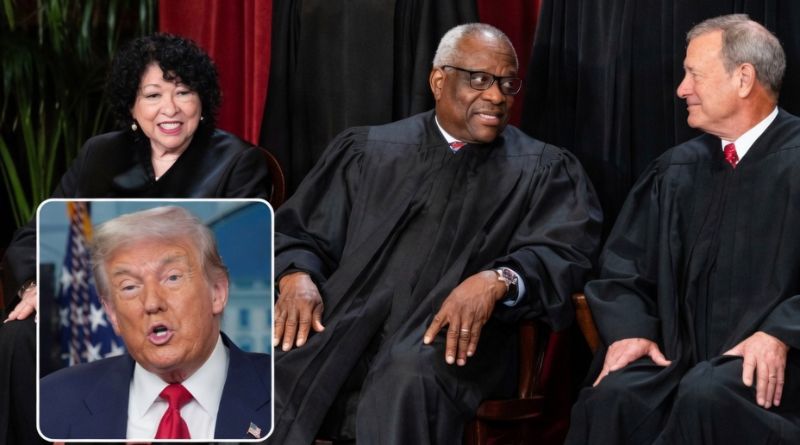
As the Supreme Court of the United States approaches the end of its 2025–2026 term, several major cases remain unresolved, with decisions expected in the coming weeks. Legal analysts say the rulings could have far-reaching implications, potentially affecting interpretations of key constitutional provisions, altering the balance of power among the branches of government, and influencing the structure of U.S. elections and governance.
The pending cases address a range of significant issues, including birthright citizenship, the authority of independent federal agencies, enforcement of voting rights laws, and campaign finance regulations. Together, they raise fundamental questions about citizenship, executive power, minority protections, and the legal framework governing elections.
In Trump v. Barbara, the Supreme Court heard arguments regarding a provision of the Fourteenth Amendment known as “birthright citizenship.”
Argued on April 1 in a rare oral argument session attended by President Donald Trump, the case centers on whether Executive Order 14160—signed on the first day of his second term—complies with the Citizenship Clause of the Fourteenth Amendment.
The order directs federal agencies not to issue citizenship documentation to children born in the United States if their mother was either in the country unlawfully or present on a temporary visa, and their father was neither a U.S. citizen nor a lawful permanent resident. According to estimates cited in the case, the policy could affect approximately 150,000 children each year.
The amendment clause reads: “All persons born or naturalized in the United States, and subject to the jurisdiction thereof, are citizens of the United States and of the State wherein they reside.”
Since United States v. Wong Kim Ark, decided in 1898, the Citizenship Clause of the Fourteenth Amendment has generally been interpreted to grant citizenship to nearly all individuals born on U.S. soil, regardless of their parents’ immigration status.
In the current case, the administration argues that the phrase “subject to the jurisdiction thereof” should be interpreted more narrowly, requiring a higher level of political allegiance and potentially excluding children born to parents who are in the country unlawfully or on temporary visas.
Argued in December 2025, Trump v. Slaughter could have significant long-term implications for the structure of federal governance. The case centers on whether Congress has the authority to protect members of independent agencies from being removed by the president at will.
In 2025, President Trump removed Federal Trade Commission members Rebecca Kelly Slaughter and Alvaro Bedoya without cause, despite a provision in the FTC Act of 1914 that limits removal to cases of “inefficiency, neglect of duty, or malfeasance in office.” The dispute has renewed focus on Humphrey’s Executor v. United States, in which the Supreme Court upheld such protections for officials serving in agencies with quasi-legislative and quasi-judicial functions.
A decision in favor of the administration could have broader implications for the independence of agencies including the Federal Trade Commission, Securities and Exchange Commission, National Labor Relations Board, Equal Employment Opportunity Commission, and Federal Energy Regulatory Commission, as well as potentially others such as the Federal Reserve in related litigation.
During oral arguments, several conservative justices expressed skepticism about the continued viability of Humphrey’s Executor in light of the expanded role of modern administrative agencies. The Court has already issued a stay of lower-court orders that would have reinstated Slaughter and Bedoya, allowing their removal to remain in effect while the case is pending. Observers say the outcome could determine whether longstanding limits on presidential removal authority are narrowed or reaffirmed.
Louisiana v. Callais could have significant implications for voting rights law in the United States. The case originated as a challenge to Louisiana’s congressional map under Section 2 of the Voting Rights Act of 1965, which prohibits electoral practices that dilute the voting strength of minority groups.
After a lower court determined that the state’s map diluted the voting power of Black residents—who make up roughly one-third of Louisiana’s population—the legislature adopted a revised map that included two majority-Black districts.
That revised map was subsequently challenged by a group of non-Black voters, who argue it constitutes an unconstitutional racial gerrymander. If plaintiffs win, several states would redraw congressional maps without using race as a factor, thereby likely handing Republicans dozens more congressional seats.
Then, “In West Virginia v. B.P.J. and Little v. Hecox, the court will opine on the permissibility of state laws banning transgender girls and women from participating in girls’ and women’s sports teams. The opinions are expected to examine whether such bans violate Title IX or the Equal Protection Clause,” Just the News reported.