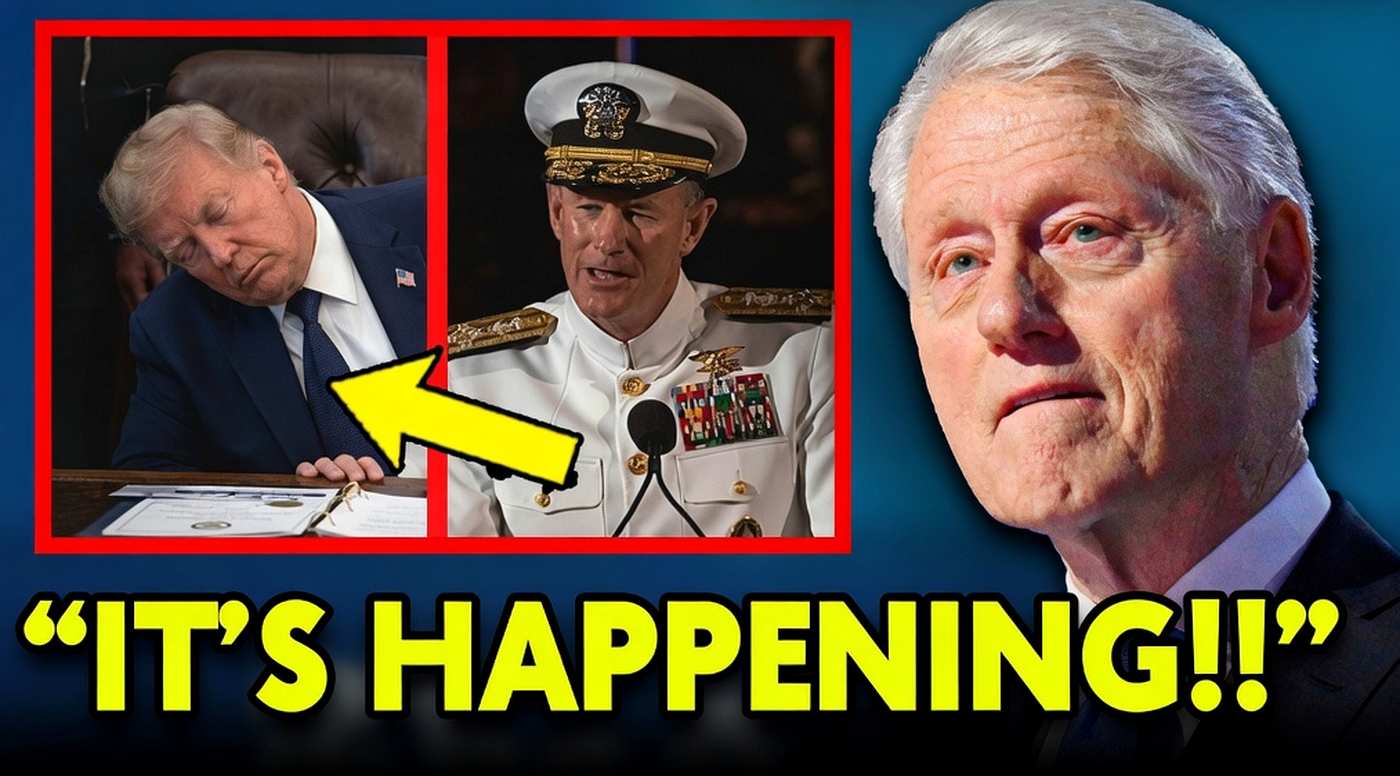
WASHINGTON, D.C. — In a rare and somber address that echoed the gravity of an Oval Office “fireside chat,” former President Bill Clinton stepped into the public eye today, not to campaign, but to “level with the American people.” Standing against a backdrop of escalating military tension and domestic economic strain, Clinton delivered a blistering assessment of what he calls a “strategic and constitutional testing point” for the United States.
At the heart of his message was a singular, chilling signal: a “flare going up over the republic” triggered by the recent public warnings of Admiral William McRaven, the Navy SEAL commander who oversaw the 2011 raid on Osama bin Laden.
As the confrontation with Iran reaches its 60th day, the intersection of military law, global energy security, and institutional integrity has created a perfect storm. “This isn’t about one man in the White House or one admiral at a podium,” Clinton warned. “It’s about whether the guardrails our founders built—the chain of command, the rule of law, and the oath to the Constitution—still hold when they’re tested.”
The McRaven Warning: Lawful vs. Unlawful Orders
The catalyst for this national conversation is Admiral McRaven’s unprecedented reminder to American service members: they have a legal and moral obligation to refuse unlawful orders.
This is not a theoretical debate. McRaven’s warning was issued in direct response to the administration’s “no quarter, no mercy” rhetoric and floating suggestions of strikes on civilian infrastructure, such as bridges and power stations.
-
The Legal Line: Under the Uniform Code of Military Justice (UCMJ) and the Geneva Conventions, deliberately targeting civilian infrastructure with no clear military necessity is a war crime.
-
Individual Responsibility: Clinton emphasized that the “I was just following orders” defense died at Nuremberg. A captain or major who carries out a strike on a civilian target is personally liable under international and American law.
-
The Reality of the Room: Most disturbingly, McRaven confirmed that these conversations—deliberating on targets that blur the line of legality—are happening in real-time between senior military officers and the Secretary of Defense.

The Strategic Reality: Iran is Not a Seminar
Beyond the legalities, Clinton and McRaven are sounding the alarm on a fundamental misunderstanding of the Iranian theater.
The Three Sobering Facts:
-
Scale: Iran is two and a half times the size of Texas. A ground operation is not a “three-day affair.”
-
Historical Precedent: The U.S. has never successfully “bombed its way to victory.” Air power can degrade capability, but it rarely achieves long-term political stability.
-
The Regime Paradox: Intelligence suggests that removing the current Supreme Leader could lead to a more hardline, reactionary regime, rather than a democratic opening.
The “Hormuz Trap”:
The closure of the Strait of Hormuz was the most predictable move on the board. For 30 years, every Pentagon war game has anticipated this. Yet, the U.S. response has been characterized as “too late,” leading to a spike in global energy prices that is crushing household budgets from Akron to Phoenix.
The Arsenal of Democracy: Running on Empty?
Perhaps the most shocking revelation comes from General Wesley Clark, former NATO Supreme Commander. His reports suggest that the “Arsenal of Democracy” is showing signs of severe exhaustion after only two months of “short-term” conflict.
| Weapon System | Remaining Inventory |
| Tomahawk Missiles | Below 50% |
| Ballistic Missile Interceptors | ~66% (Burned through 1/3) |
| THAAD Interceptors | ~50% (Nearly half gone) |
“These weapons take years to replace,” Clinton noted. “When you spend the cupboard bare without a clear endgame, that isn’t strength. That’s strategic overreach that leaves America exposed in every other corner of the world.”
The Institutional Purge: The Silence at the Top
In a statistic that should “make every American sit up straight,” roughly 30 general officers have been fired or forced out in the last year. Admiral McRaven described this as a “cascading effect on morale.”
The result is a culture of fear where senior officers are afraid to speak truth to power. Clinton recalled his own time in the Oval Office, working with legends like Colin Powell and Hugh Shelton. “There were days those men told me things I did not want to hear,” he said. “And thank God they did. A president who only hears what he wants to hear makes worse decisions every single time.”
When honesty is punished, the military doesn’t become more loyal—it becomes silent. And silence at the top of the Pentagon is how nations stumble into avoidable catastrophes.
The Soft Power Inheritance: USAid and Alliances
The dismantling of America’s “soft power”—specifically USAid—was another point of deep concern. From the 2004 tsunami to the Haiti earthquake, America’s ability to win “without firing a shot” has been its greatest strategic advantage.
Similarly, the “improvisation dressed up as strategy” regarding NATO has left London, Paris, and Berlin in a state of shock. “You cannot run a coalition by surprise in a couple of tweets,” Clinton said, noting that allies are sovereign democracies with their own parliaments and voters to answer to.
Three Forks in the Road
President Clinton concluded by laying out the three potential paths the country now faces:
-
The Strategic Fork: Iran, feeling the pressure, may accelerate its nuclear program. Professor Robert Pape warns that Iran is now working with its allies (Russia and Pakistan) better than the U.S. is working with its own.
-
The Constitutional Fork: If illegal orders are issued and the chain of command breaks, the republic enters territory it has not visited since its founding.
-
The Economic Fork: A prolonged blockade of the Strait of Hormuz will crush the global economy. Iran has offered an “off-ramp”—lift the blockade, open the strait. Clinton argues this deserves a diplomat’s pen, not a “Twitter announcement.”
A Call to “Self-Government”
In his closing remarks, Clinton reminded the nation that democracy is not a gift handed down by the powerful, but a responsibility carried by the public.
“The military takes an oath to the Constitution, not to any one man. That sentence is the whole ballgame,” he said. “We are not a country that breaks easily. We are a country that bends, remembers, and rises. We still have time to get this right.”
As the “flare” hangs over the republic, the question remains whether the administration will hear the warning or continue to steer by the light of the fire.