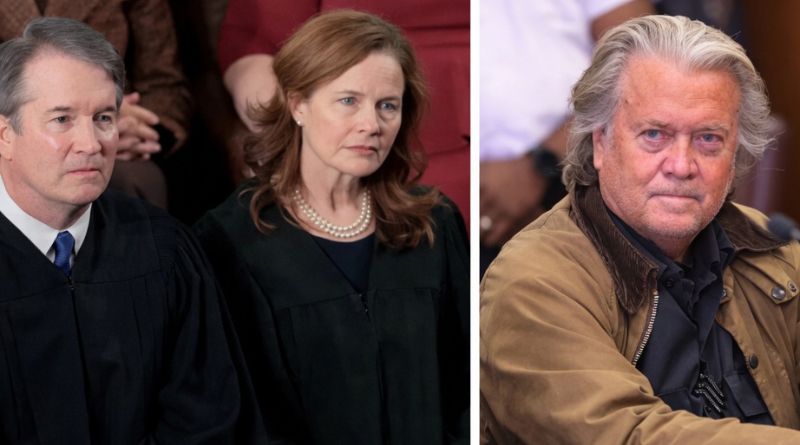
Conservative speaker Steve Bannon just won a big case at the U.S. Supreme Court, which could likely pave the way for his conviction for contempt of Congress to be thrown out.
On Monday, the Supreme Court threw out a lower court’s decision that upheld Bannon’s conviction for not following a subpoena from the House committee that looked into the Capitol riot on January 6, 2021. The Trump administration requested a reevaluation of the case, prompting the move.
Now that the appellate ruling has been thrown out, a trial judge can act on the administration’s request to throw out the case “in the interests of justice.”
At this point, any dismissal would mostly be a show of support. Bannon had already served four months in prison after a jury found him guilty in 2022. A federal appeals court in Washington had already upheld that conviction.
In a different case involving former Cincinnati City Councilman P.G. Sittenfeld, who was pardoned by President Donald Trump last year, the Supreme Court gave a similar order. Sittenfeld had been in prison for 16 months after being found guilty of bribery and attempted extortion in 2022. The court’s decision makes it possible for a lower court to also think about throwing out that indictment.
The Justice Department first charged Bannon while Joe Biden was president, but they changed their minds after Trump took office.
Bannon said that Trump’s executive privilege protected him from having to testify. The Jan. 6 committee and federal prosecutors disagreed, saying the argument didn’t hold up because Bannon had been fired from the White House in 2017 and was a private citizen when the events in question happened.
Bannon also pleaded guilty in a New York state case that had to do with a private effort to raise money for building a wall on the southern border. The plea deal kept him out of jail, and the Supreme Court’s most recent decision doesn’t change the conviction.
In a separate case, the Supreme Court has allowed the Trump administration to temporarily halt more than $65 million in federal education grants, siding with the government in an ongoing legal dispute over funding tied to diversity initiatives.
In a 5–4 decision, the court blocked a lower court order that had required the U.S. Department of Education to reinstate the grants while litigation proceeds.
The funding had been terminated earlier this year after officials determined that certain programs included what they described as objectionable diversity, equity, and inclusion (DEI) content.
The unsigned majority opinion emphasized that once federal funds are distributed, they are often difficult or impossible for the government to recover. The justices also concluded that the states challenging the cuts would not suffer permanent harm if the funding remains paused during the legal process.
The dispute centers on two federal grant programs designed to address a nationwide teacher shortage. The Department of Education canceled the vast majority of grants—more than 100 in total—following internal reviews of program content.
A coalition of eight states, led by California, filed suit in federal court, arguing that the administration violated federal administrative law by abruptly terminating the funding. The states contended that universities and nonprofits rely on the grants to train new teachers and that the cuts would disrupt critical workforce pipelines.
A federal district judge in Massachusetts, Myong Joun, issued a temporary restraining order requiring the government to restore the funding in the plaintiff states. The order also barred further terminations while the case moved forward.
However, the Supreme Court determined that it could intervene despite the temporary nature of the lower court’s order, reasoning that it functioned similarly to a preliminary injunction, which is typically subject to appeal.
The Trump administration had argued that allowing the lower court ruling to stand would set a precedent enabling federal judges to override executive branch decisions on funding.
The majority appeared to agree, suggesting the administration is likely to prevail in its argument that the district court lacked authority to order the payments.