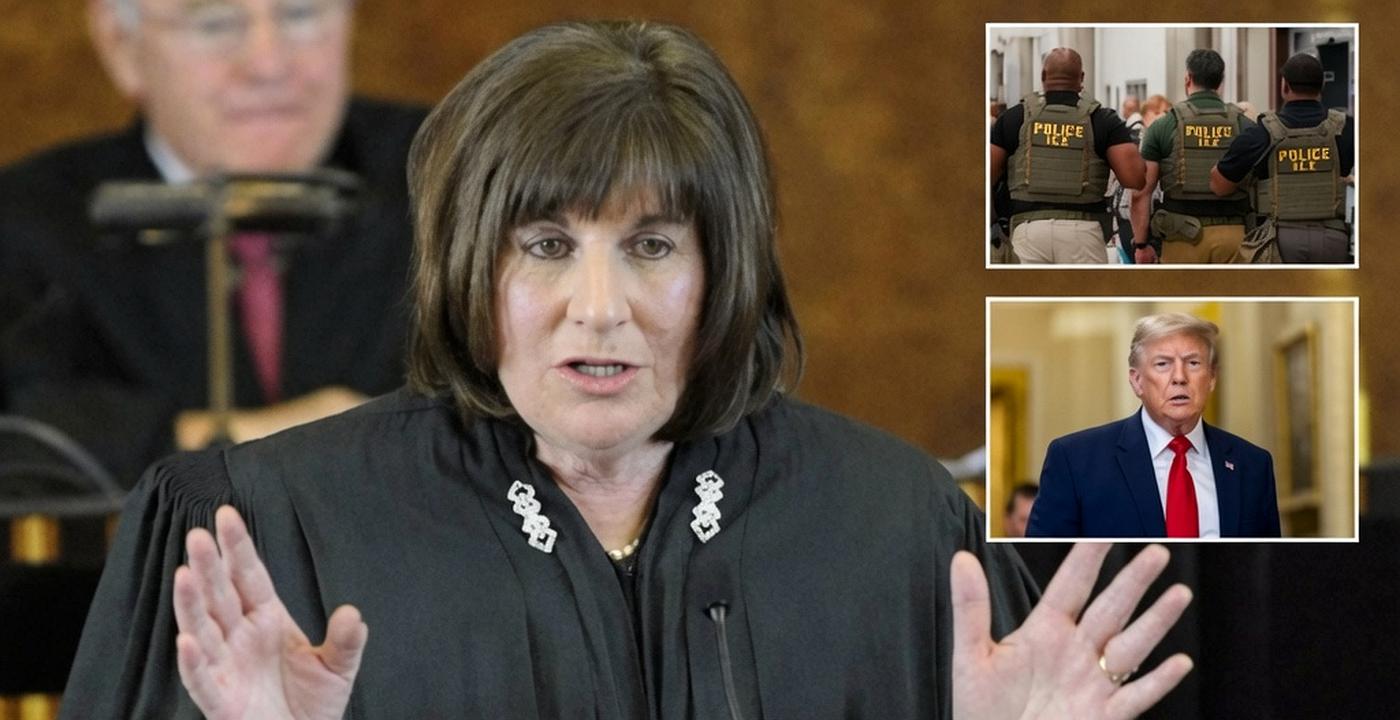
A federal judge on Monday delivered a significant win for the Trump administration and the principle of federal supremacy, blocking key parts of a New York law that sought to force Immigration and Customs Enforcement agents and other federal officers to operate without face coverings and with visible identification.
U.S. District Judge Mae A. D’Agostino of the Northern District of New York, an Obama appointee, issued a 51-page decision granting the Department of Justice a preliminary injunction against the state’s Face Covering and Identification Acts.
The ruling prevents New York from enforcing requirements that would have prohibited federal law enforcement—including ICE, the FBI, DEA, and Customs and Border Protection—from wearing any face covering that conceals identity while interacting with the public, and from operating without clearly displayed identification such as a name, badge, or shield number.
“New York cannot impose its own uniform requirements on federal agents simply because it disagrees with how the Federal Government is exercising its authority,” D’Agostino wrote.
D’Agostino emphasized that the Constitution’s Supremacy Clause bars states from regulating federal officers in the performance of their duties.
“Settled law establishes that federal, not state, authorities make the policies that animate the enforcement of federal immigration laws,” D’Agostino wrote.
The judge acknowledged New York’s claimed concerns about transparency but made clear that policy disagreements do not override the Constitution.
“The issue now before the Court is about constitutionality—not transparency or preferable policy decisions,” D’Agostino stated.
“New York appears to be well-intentioned in its pursuit of transparent policing,” yet that does not allow the state to dictate how federal agents carry out national immigration enforcement.
The challenged provisions were tucked into the state’s 2026 budget bill, signed by Democratic Gov. Kathy Hochul on May 27 and effective June 26.
Democratic lawmakers and immigrant advocacy groups framed the measures as necessary accountability after the Trump administration ramped up interior enforcement operations.
Critics, including federal officials, warned that forcing agents to show their faces would expose them to doxxing, harassment, and physical threats from activists who have increasingly targeted immigration officers.
The Justice Department sued New York in late June, arguing the laws unconstitutionally interfered with federal operations and endangered officer safety.
D’Agostino sided with the government on the mask and identification rules, finding the United States was likely to succeed on the merits.
In a partial setback for the administration, the judge denied the request to block the state’s separate Local Cops Local Crimes Act, also known as the Termination Act.
That measure, set to take effect August 25, restricts local police and jails from entering 287(g) agreements that allow them to assist ICE with civil immigration enforcement.
D’Agostino ruled that states retain authority over their own resources and personnel, describing the ban as a legitimate exercise of New York’s police powers.
The decision marks another success for the Trump administration in challenging similar state efforts.
A federal court earlier blocked a comparable California mask ban, and the 9th Circuit has restricted related identification requirements.
New York officials responded with defiance.
Hochul and Attorney General Letitia James issued a joint statement saying they “stand firm in our belief that masked agents do not make New York safer” and are reviewing legal options.
Department of Justice officials hailed the ruling as a defense of law and order.
A DOJ spokesperson noted that the department “will not tolerate any violence directed toward law enforcement officials working tirelessly to keep Americans safe.”
Overall, the ruling reinforces that blue-state attempts to micromanage federal immigration agents cross a clear constitutional line.
While local non-cooperation policies remain in place for now, the decision protects ICE’s operational flexibility at a time when the administration is prioritizing removals and border security.
Moving forward, the case will proceed toward a full trial on the merits.
New York may appeal the injunction, but the strong language on the Supremacy Clause creates a powerful precedent likely to deter similar laws in other progressive states.