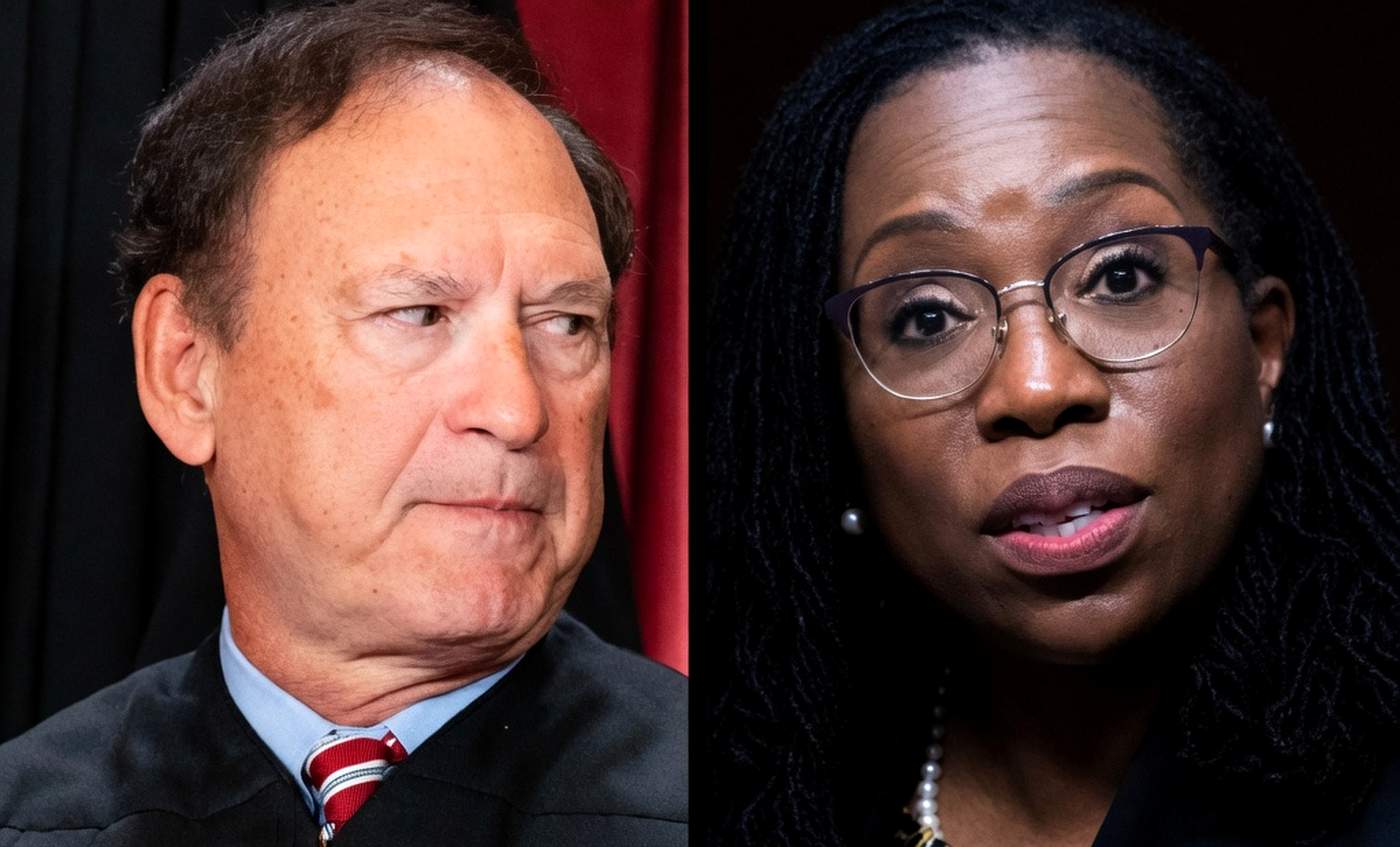
A bitter internal dispute at the Supreme Court of the United States spilled into public view this week after Justice Samuel Alito sharply criticized fellow Justice Ketanji Brown Jackson over her dissent in a major Louisiana redistricting case with significant implications for the 2026 midterm elections.
The conflict emerged after the Supreme Court moved to fast-track implementation of its recent ruling involving Louisiana’s congressional map, a decision expected to reshape the state’s districts in ways likely favorable to Republicans.
In an unusually forceful concurring opinion joined by Justices Neil Gorsuch and Clarence Thomas, Alito accused Jackson of making “groundless and utterly irresponsible” claims about the Court’s motives and conduct.
“The dissent goes on to claim that our decision represents an unprincipled use of power,” Alito wrote. “That is a baseless and insulting charge.”
🚨 JUSTICE SAMUEL ALITO HAS HAD IT WITH KETANJI BROWN JACKSON
Joined by Clarence Thomas and Neil Gorsuch, Alito EVISCERATED Jackson for her combative and "insulting" dissent:
"Instead the dissent offers 2 reasons for its proposed course of action. One is TRIVIAL at best, and… pic.twitter.com/u4idr8ALPT
— Eric Daugherty (@EricLDaugh) May 5, 2026
The dispute followed an unsigned order allowing Louisiana officials to proceed quickly with implementing revised congressional districts after the Court’s earlier 6-3 ruling narrowed the scope of Section 2 of the Voting Rights Act. The decision concluded that Louisiana’s previous congressional map amounted to unconstitutional racial gerrymandering.
Jackson was the sole justice to publicly dissent from the Court’s latest procedural move. Even the Court’s other left-wing justices declined to join her opinion, highlighting her increasingly isolated position in several recent high-profile disputes.
In her dissent, Jackson argued the Court was intervening too aggressively in an ongoing election process and warned that the accelerated timeline risked creating “the appearance of partiality.” She maintained that the Court should have waited before formally transmitting its judgment to lower courts, citing the traditional 32-day period normally observed before rulings take effect.
Alito rejected that argument outright, calling the objection “trivial at best” and accusing Jackson of prioritizing procedural technicalities over practical realities facing state election officials.
“The dissent accuses the Court of ‘unshackling’ itself from ‘constraints,’” Alito wrote. “It is the dissent’s rhetoric that lacks restraint.”
The Court’s ruling now sends Louisiana officials scrambling to finalize congressional boundaries ahead of the midterms. Ballots had already begun moving through portions of the election process, and state primaries were temporarily paused amid the legal uncertainty.
The broader implications extend well beyond Louisiana. Election law experts say the Court’s earlier ruling weakening the use of race in congressional redistricting could reshape maps across multiple Southern states and potentially alter the balance of power in the U.S. House of Representatives heading into 2026.
The unusually personal tone of the exchange between Alito and Jackson immediately drew attention from legal analysts and court observers.
Jonathan Turley, a law professor at George Washington University, described the concurrence as evidence that tensions inside the Court are becoming increasingly public and increasingly sharp.
“Justice Alito had had enough,” Turley wrote in commentary following the ruling, arguing that the conservative justice viewed Jackson’s accusations of judicial overreach as an attack on the legitimacy of the Court itself.
Legal analyst Jonathan Turley sharply criticized Justice Jackson in a recent column examining the Supreme Court’s handling of the Louisiana redistricting dispute. Writing about the Court’s decision to fast-track implementation of its ruling in Louisiana v. Callais, Turley argued that Jackson’s dissent crossed a line from legal disagreement into what he described as politically charged rhetoric directed at her colleagues.
Justice Jackson recently said that “I have a wonderful opportunity to tell people in my opinions how I feel about the issues, and that’s what I try to do.” For some of her colleagues, that cathartic benefit is coming at too high a cost for the Court. https://t.co/SGtZMbHH0h
— Jonathan Turley (@JonathanTurley) May 5, 2026
“What is even more chilling than Jackson’s jurisprudence is the fact that she is often cited as the model for Democrats seeking to pack the Court with an instant majority if they retake power,” Turley wrote. “This and other Jackson dissents show why Democrats are so confident that packing the Court will yield lasting control of the government.”