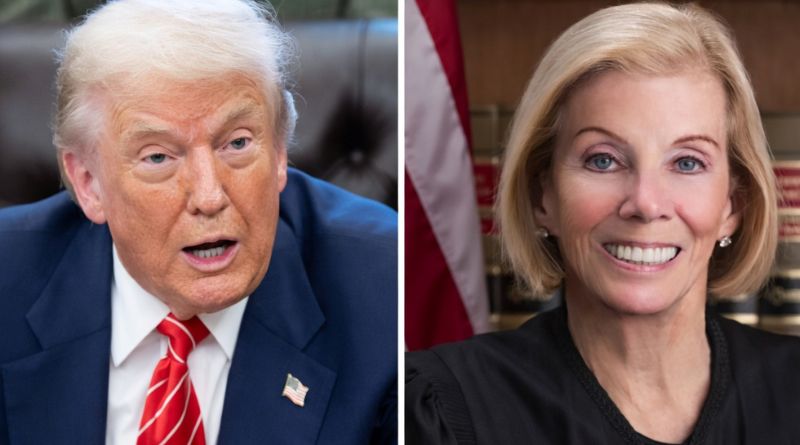
A federal judge in Los Angeles granted the Trump administration a legal victory on Monday by issuing a preliminary injunction against California’s “No Secret Police Act,” a state law that prohibits ICE agents from wearing masks during enforcement operations.
U.S. District Judge Christina Snyder, whom President Bill Clinton appointed, ruled that the law unlawfully discriminates against federal officers by targeting them specifically while exempting state and local law enforcement.
The court struck down the law on constitutional grounds, not based on policy considerations.
“The Court finds that federal officers can perform their federal functions without wearing masks. However, because the No Secret Police Act, as presently enacted, does not apply equally to all law enforcement officers in the state, it unlawfully discriminates against federal officers,” Snyder wrote.
She also cited the Constitution’s Supremacy Clause, which essentially states that federal laws supersede state laws.
Attorney General Pamela Bondi praised the ruling in a post on X Monday. She stated that federal agents are increasingly targeted for performing their duties and warned that the law would exacerbate existing safety risks.
“ANOTHER key court victory thanks to our outstanding @TheJusticeDept attorneys. Following our arguments, a district court in California BLOCKED the enforcement of a law that would have banned federal agents from wearing masks to protect their identities. These federal agents are harassed, doxxed, obstructed, and attacked on a regular basis just for doing their jobs. We have no tolerance for it,” Bondi said.
The court ruling blocked the facial-covering ban but upheld the state’s “No Vigilantes Act,” which requires all officers to display their agency affiliation and a personal identifier, such as a badge number, on their uniforms.
California Governor Gavin Newsom described the ruling as a “win,” highlighting that it supports his policy objectives, even though the court struck down the other measure.
“A federal court upheld California’s law requiring federal agents to identify themselves – a clear win for the rule of law. No badge and no name mean no accountability,” Newsom said. “California will keep standing up for civil rights and our democracy.”
Last September, Newsom signed the Democrat-pushed measures into law in response to federal immigration law enforcement operations in California. The state argued that these laws were valid safety regulations, comparing them to speed limits and other traffic laws.
This comes as nine people were convicted by a federal jury on Friday for their roles in last year’s attack on an ICE detention facility in Texas.
Federal prosecutors described this case as the first-ever terrorism trial involving adherents of “antifa.”
Authorities identified one man, Benjamin Song, as the ringleader of an antifa cell in northern Texas. He was convicted of attempted murder after a police officer was injured during the attack.
The other eight individuals were convicted for their support of the attack, facing charges that included rioting and possession of explosives.
President Trump designated Antifa a domestic terrorist organization last fall, citing what his administration described as anti-government views shared among its supporters.
Some experts have challenged that designation, arguing that Antifa is better understood as a loose movement or ideology rather than a formal organization.
The July 4 attack targeted the U.S. Immigration and Customs Enforcement Prairieland Detention Center, a facility where migrants are held while awaiting deportation proceedings.
The group first launched fireworks at the facility as a distraction. When local police responded to the scene, gunfire erupted.
According to testimony from Lt. Thomas Gross of the Alvarado Police Department, he was struck in the neck after shots were fired. Gross told the court that he heard Benjamin Song shout, “get to the rifles,” moments before the gunfire began.
Several individuals involved later said they believed they were attending what had been described as a “noise demonstration,” intended to show support for detained migrants and protest the actions of U.S. Immigration and Customs Enforcement.
Federal prosecutors, however, said the events that unfolded that night went far beyond a demonstration, describing the incident as a coordinated and violent attack on law enforcement.
In addition to Song, the others convicted were Cameron Arnold, also known as Autumn Hill; Zachary Evetts; Savanna Batten; Bradford Morris, also known as Meagan Morris; Maricela Rueda; Elizabeth Soto; Ines Soto; and Daniel Rolando Sanchez-Estrada.