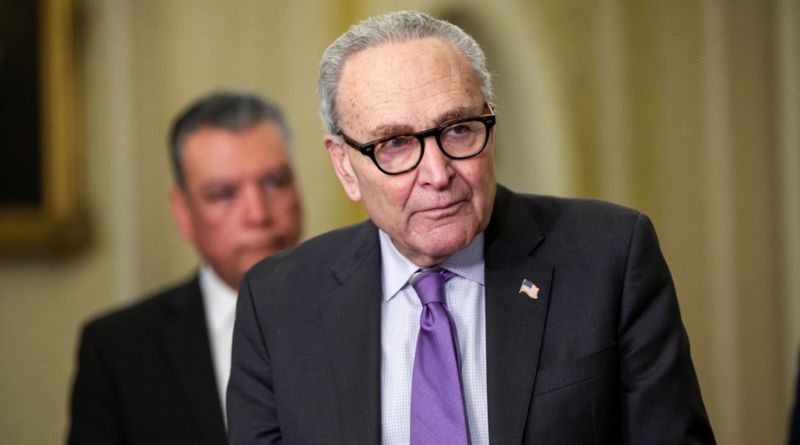
Democrats’ efforts to reclaim control of the U.S. Senate are increasingly intersecting with internal divisions over party leadership, and the growing disputes have placed Minority Leader Chuck Schumer (N.Y.) at the center of a broader debate about strategy and direction.
In Maine, Schumer has endorsed Gov. Janet Mills in a key Senate race. However, several Democratic senators have backed insurgent left-wing candidate Graham Platner, despite his personal controversies and baggage, signaling disagreement with Schumer’s approach, The Associated Press reported.
Similar divisions are emerging in other battleground states, including Michigan and Minnesota. In those races, progressive lawmakers have thrown their support behind non-establishment candidates instead of those aligned with party leadership.
The disagreements extend beyond individual races and reflect a broader struggle within the Democratic Party. Candidates and strategists are questioning whether traditional campaign strategies remain effective in the current political environment.
At issue is whether party leadership should change course following recent election results. Some Democrats argue that the party must adopt a new approach after Donald Trump secured a second term.
Sen. Martin Heinrich of New Mexico said the divide reflects a disagreement over strategy. “Clearly there’s a disagreement of strategy here,” Heinrich said.
Heinrich said the party must reassess its approach to upcoming elections. “The business-as-usual calculation for what is going to be successful in a given election cycle does not necessarily, in my view, meet the moment,” he said.
The internal debate follows the 2024 election cycle, when former President Joe Biden initially ran for reelection. Biden later withdrew from the race and endorsed Vice President Kamala Harris, who lost to Trump.
Some Democrats say those events contributed to frustration within the party’s base. The dissatisfaction has fueled calls for new leadership and a shift in messaging. The Washington Times reported.
Nan Whaley, a Democratic strategist and former Ohio gubernatorial candidate, said the divide is no longer centered on ideology alone. She said it is increasingly about trust in party leadership.
“It’s really about, who do you trust? Establishment or not establishment,” Whaley said. “And frankly, the establishment hasn’t given us a lot to trust these past few years,” she said.
The Maine race has become a focal point for the broader conflict. Platner, who has positioned himself as an outsider candidate, has drawn support from lawmakers who are critical of the party’s current direction.
Endorsements in that race have underscored tensions within the Senate Democratic caucus. Some senators have backed Platner as a signal of dissatisfaction with existing leadership strategies.
In Michigan, a similarly competitive primary has highlighted the divide between establishment and anti-establishment candidates. Several contenders have questioned whether current leadership reflects the priorities of voters.
Minnesota’s Senate race has also become a test of the party’s future direction. Candidates have split along ideological lines, with endorsements reflecting differing visions for how Democrats should compete nationally.
Despite the public criticism, no Democratic senator has formally challenged Schumer for leadership. Senate leadership elections are conducted by secret ballot, requiring majority support within the caucus.
Political analysts said Schumer’s position may ultimately depend on election outcomes. Strong results could reinforce his leadership, while losses could intensify calls for change.
The debate reflects broader questions about how Democrats should respond to shifting political dynamics. Some candidates argue that a new generation of leaders is needed to connect with voters and address current challenges.
Others maintain that experience and continuity remain critical as the party seeks to regain control of the Senate. The competing views have created a complex landscape heading into the next election cycle.
For now, Democratic candidates continue to campaign on differing visions for the party’s future. The outcome of these races could shape not only Senate control but also the direction of party leadership in the years ahead.